
Commercial Times / China Times 2023.7.12
https://www.chinatimes.com/newspapers/20230712000323-260210?chdtv
With continuous advancements in medical technology, NanoRay Biotech places great importance on children’s growth and development. The company has introduced RevoluX, a next-generation hand X-ray system featuring ultra-low radiation exposure. Compared with traditional X-ray equipment, RevoluX features a compact design and enhanced safety protection, allowing children to undergo hand imaging in a safer and more comfortable environment.
In clinical practice, evaluating a child’s development involves not only chronological age but also bone age, which provides important insight into growth potential. Many parents closely monitor their child’s height during developmental years, as children may feel self-conscious if they perceive themselves to be shorter than their peers. With RevoluX, a single X-ray image of the left hand and wrist can be used to assess skeletal maturity and growth plate closure, enabling physicians to determine bone age and better understand the child’s growth status compared to their actual age.
According to Dr. Nan-Hung Chen, Director of Le lune Clinic, RevoluX offers significant advantages for clinical use. Its compact size, enclosed radiation source, and ability to precisely capture hand images make it particularly suitable for pediatric examinations. The radiation dose is only one-fifth of that of conventional X-ray systems, minimizing exposure to other organs. Parents or healthcare staff may also remain with the child during imaging, providing reassurance and a more comfortable examination experience.
Traditional large-scale X-ray systems typically require dedicated space, making installation challenging for many primary pediatric clinics with limited facilities. As a result, parents are often referred to hospitals or imaging centers for bone age examinations. The introduction of RevoluX allows healthcare providers to significantly reduce space requirements while benefiting from AI-assisted diagnostic reports, enabling physicians to deliver accurate assessments and comprehensive pediatric growth management solutions.
Dr. Chen recommends that children begin monitoring growth curves and bone age from around the age of seven. Depending on individual conditions, imaging every three to six months can help track skeletal development. For example, if a 14-year-old child has a bone age of 12, it may indicate slower development but also suggests continued growth potential. Conversely, if a 10-year-old child shows a bone age of 12, physicians may evaluate the need for medical intervention based on overall growth conditions. Early monitoring is therefore essential for supporting optimal growth outcomes.
NanoRay Biotech aims to help make bone age assessment more accessible across Taiwan’s healthcare institutions. Because children’s growth cannot wait, the company is committed to supporting the next generation through healthier and more confident development.
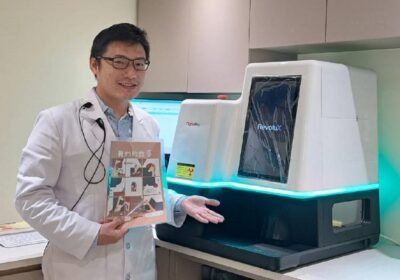 Dr. Nan-Hung Chen noted that the compact RevoluX hand X-ray system delivers only one-fifth the radiation dose of conventional systems, providing a safer and more comfortable imaging experience for children.
Photo courtesy of NanoRay Biotech.